
A typical gym space tour looks like this.
You walk the floor.
Check the ceiling height.
Picture where the squat racks will go.
Ask about parking.
Eventually someone points to the roof and says:
"There are two HVAC units serving the space."
The listing agent says it like that solves the problem.
Everyone nods.
The tour moves on.
But that sentence hides one of the most misunderstood parts of leasing a gym.
Because when a listing agent says a space “has HVAC”, they usually mean one thing:
The building has air conditioning.
What they don’t mean is:
The system is sized properly for a gym.
The ductwork distributes air correctly.
Or that the tenant won’t be responsible when it breaks.
Those details almost always live inside the lease.
Which is exactly the type of thing we slow down and unpack when working with gym owners. Touring buildings is the easy part. Understanding what you're actually inheriting inside the lease is where things get interesting.
First: What HVAC Actually Means
HVAC stands for:
Heating
Ventilation
Air Conditioning
But in commercial real estate, HVAC refers to far more than just the rooftop units.
A complete HVAC system includes:
Rooftop units
Ductwork
Air distribution
Return air systems
Thermostats and controls
Insulation around duct runs
Think of it like the circulatory system of the building.
The units generate the air.
The ductwork moves the air.
The insulation keeps the system efficient.
If any part of that system is poorly designed, the building may never cool properly.
And gyms place far more stress on HVAC systems than most other tenants.
Why Gyms Are Hard On HVAC Systems
Retail buildings are designed with a very different use in mind.
Typical retail assumptions look like this:
A handful of employees.
A few customers browsing.
Minimal physical activity.
Now compare that to a group fitness class.
Thirty people.
Moving constantly.
Generating body heat.
All inside one room.
The cooling demand changes dramatically.
A building that feels perfectly comfortable as a clothing store can feel like a sauna once it becomes a gym.
HVAC Sizing: The Rule Of Thumb
Cooling capacity is measured in tons.
One ton equals roughly 12,000 BTUs of cooling per hour.
Most retail spaces are designed with about:
1 ton per 500–600 square feet
That works fine for stores.
Not for gyms.
For group training concepts, a much safer rule is:
1 ton per 250-300 square feet
Example:
6,000 square foot group training gym
Typical retail design
≈ 10–12 tons
Recommended gym capacity
≈ 20 tons
That difference explains why many gyms struggle with cooling after opening.
What About Open Gym / Health Club Models?
Large open gyms distribute people across a wider area, which slightly reduces heat concentration.
Typical recommendations fall between:
1 ton per 350–400 square feet
Still significantly more cooling than traditional retail design.
But slightly less demanding than high-density group training spaces.
HVAC Is More Than Just The Units
Even when rooftop units are adequate, cooling problems can still happen.
Why?
Because HVAC performance depends heavily on ductwork design.
Cold air must actually reach the areas where people are training.
Common issues include:
Air dumping near the front of the space
Dead zones in training areas
Poor return air circulation
Uninsulated duct runs losing efficiency
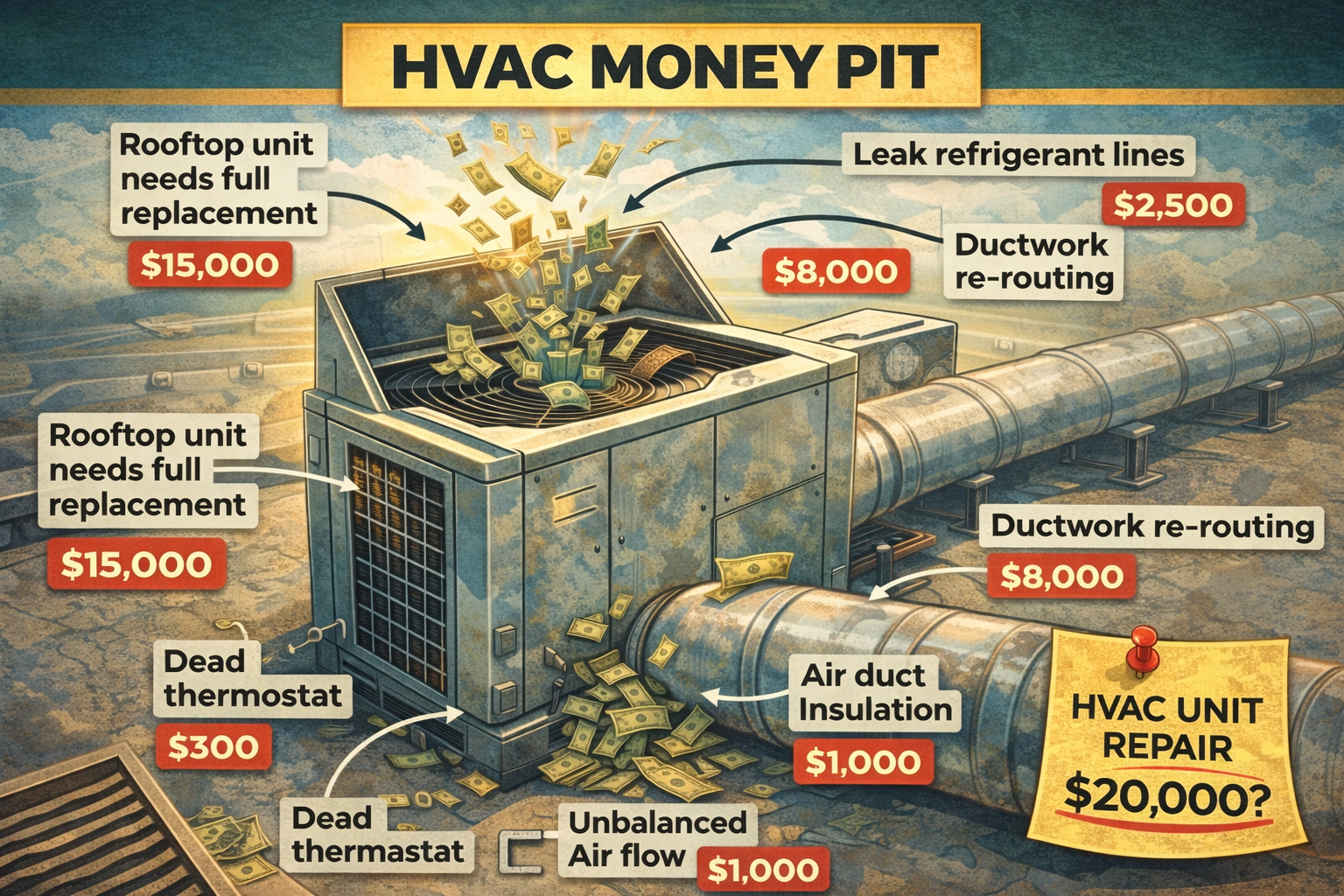
Correcting these problems can involve:
Rebalancing airflow
Adding additional ducts
Re-routing supply lines
Which can become expensive after construction.
That’s why HVAC planning should happen before signing the lease, not after the gym opens.
The Lease Language You Will Encounter
Almost every commercial lease contains a clause similar to this:
Sample Lease Language
"Tenant shall maintain the HVAC equipment serving the Premises in good working order and repair."
Translated into normal English:
You maintain the HVAC.
Not the landlord.
You.
That responsibility usually includes:
Routine service
Preventative maintenance
Repairs
And often replacement.
Yes, Replacement Too
Some leases go even further.
Example language:
"Tenant shall repair and replace the HVAC systems serving the Premises as necessary during the lease term."
Replacing a rooftop unit can easily cost:
$8,000 – $25,000 per unit
Depending on the size and installation requirements.
Which is why this clause deserves careful attention.
The Maintenance Requirement
Most leases also require tenants to maintain the system through a professional contractor.
Typical language looks like this:
"Tenant shall maintain the HVAC equipment pursuant to a preventative maintenance contract with a licensed HVAC contractor."
This means:
Quarterly service visits
Filter changes
System inspections
Skipping this step can become a problem later if the landlord questions whether the system was properly maintained.
Service records matter.
The Real Decision
The presence of HVAC units is not the real question.
The real questions are:
Is the system sized correctly for a gym?
Is the ductwork designed to distribute air properly?
Who is responsible when something breaks?
And how expensive will that responsibility become over the life of the lease?
Unfortunately, that’s a much more nuanced conversation than a single blog post can cover.
Which is why you should book a Discovery Call if you're a gym owner currently looking to lease or buy a building.
Final Thought
A gym can survive outdated paint.
It can survive worn flooring.
It cannot survive a poorly designed HVAC system.
Members will tolerate a lot.
But they will not tolerate training in a room that feels like a sauna.
Understanding the HVAC language in your lease helps ensure the building works for your business instead of against it.