
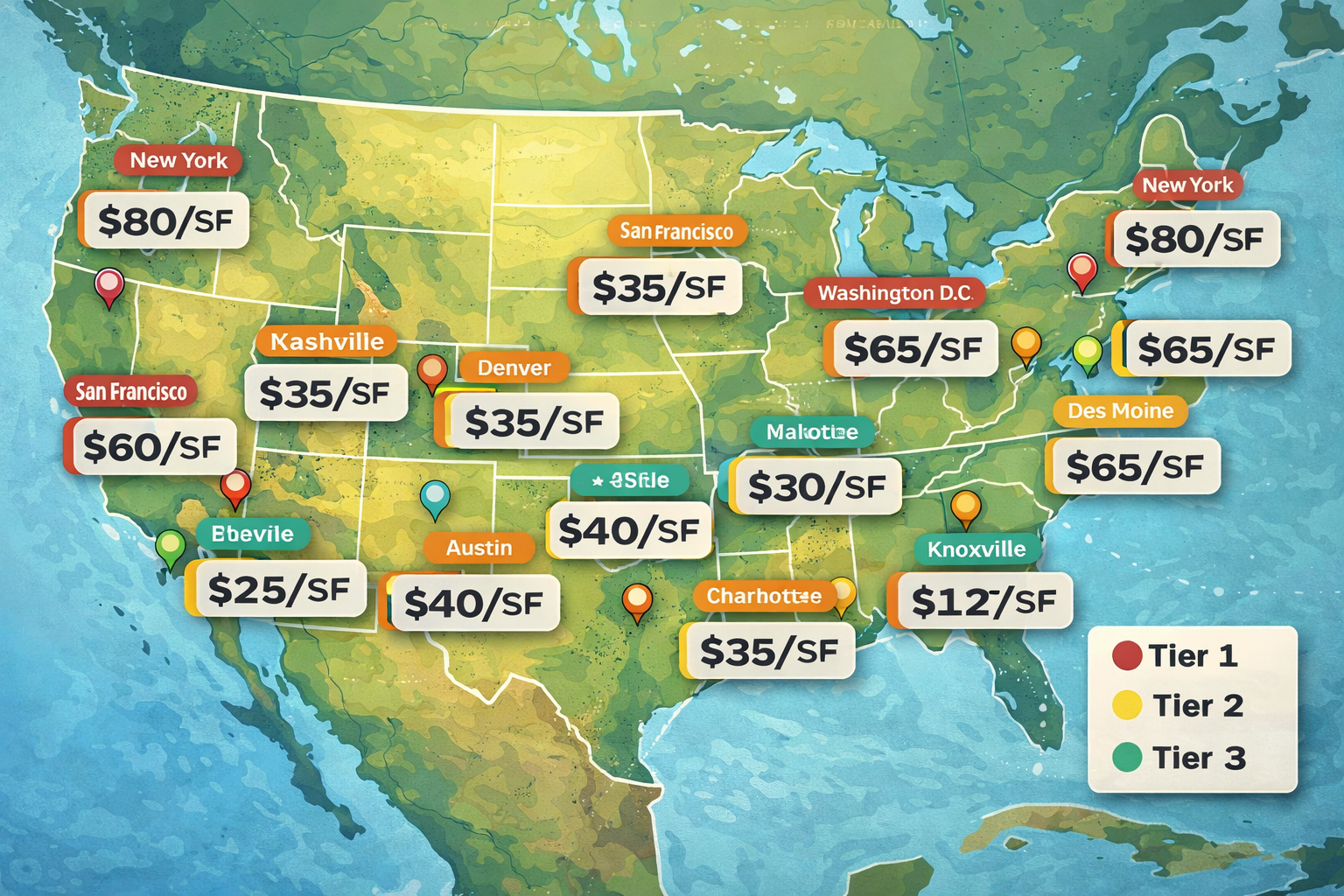
Look at enough commercial real estate listings, and you’ll start to notice something strange.
A gym space in Manhattan might cost $80 per square foot.
A similar space in Oklahoma might cost $10 per square foot.
Same size.
Same type of building.
Wildly different rent.
What explains the difference?
Commercial real estate professionals group cities into three broad categories:
Tier 1
Tier 2
Tier 3
Understanding these market tiers helps you quickly tell whether a deal is normal… or wildly overpriced.
Tier 1 Markets
Tier 1 markets are the most expensive real estate markets in the country.
Think cities like:
New York
Los Angeles
San Francisco
Boston
Washington DC
These cities have extremely high demand for space and very limited supply.
Retail rent in these markets often ranges between:
$40 to $90 per square foot
Industrial buildings typically fall between:
$20 to $40 per square foot
Opening a gym in these markets can absolutely work.
But rent becomes one of the most important financial variables in your business.
A slightly overpriced lease can quietly eat your profits for years.
Tier 2 Markets
Tier 2 markets are large, growing cities that still offer relatively reasonable real estate prices.
Examples include:
Denver
Nashville
Charlotte
Austin
Phoenix
These cities often hit the sweet spot.
Strong population growth.
Healthy incomes.
Manageable rent levels.
Retail rent in Tier 2 markets typically falls between:
$25 to $45 per square foot
Industrial buildings usually range between:
$12 to $25 per square foot
Many boutique gyms and training facilities thrive in Tier 2 cities because rent is still manageable relative to membership pricing.
Tier 3 Markets
Tier 3 markets are smaller cities where real estate is significantly more affordable.
Examples include:
Boise
Tulsa
Des Moines
Knoxville
Little Rock
These markets often offer the lowest barrier to entry for opening a gym.
Retail rent in Tier 3 markets typically ranges from:
$12 to $25 per square foot
Industrial space may fall between:
$6 to $12 per square foot
Lower rent can make the financial side of opening a gym much easier.
But smaller markets can also mean a smaller population and fewer potential members.
So the opportunity is different.
Why Rent Matters More Than Most Gym Owners Realize
Rent is usually the second-largest expense for a gym business.
Which means it needs to be treated carefully.
A simple rule many gyms follow:
Try to keep rent below about 20 percent of your gym’s revenue.
That doesn’t mean it has to be exact.
But when rent climbs much higher than that, profitability becomes harder.
Especially in the early years of the business.
The Trap Of Comparing Cities
One of the easiest mistakes to make is comparing rent across cities without context.
A $40 lease in Manhattan might actually be reasonable given the income levels and population density in the area.
Meanwhile, $20 per square foot in a small town could actually be expensive relative to local demand.
Rent only makes sense when viewed within the context of the market.
The Real Decision
Most people focus on whether the rent number looks good.
But the smarter question is whether the market supports your gym’s pricing model.
A higher-rent market with strong incomes may support a premium membership.
A lower-rent market may require lower pricing but also carry less financial pressure.
Unfortunately, that’s a much more nuanced conversation than a single blog post can cover.
Which is why you should book a Discovery Call. We'll learn about your CRE project, desired markets and walk you through our process to ensure you find the perfect building for your gym and best lease deal possible.