
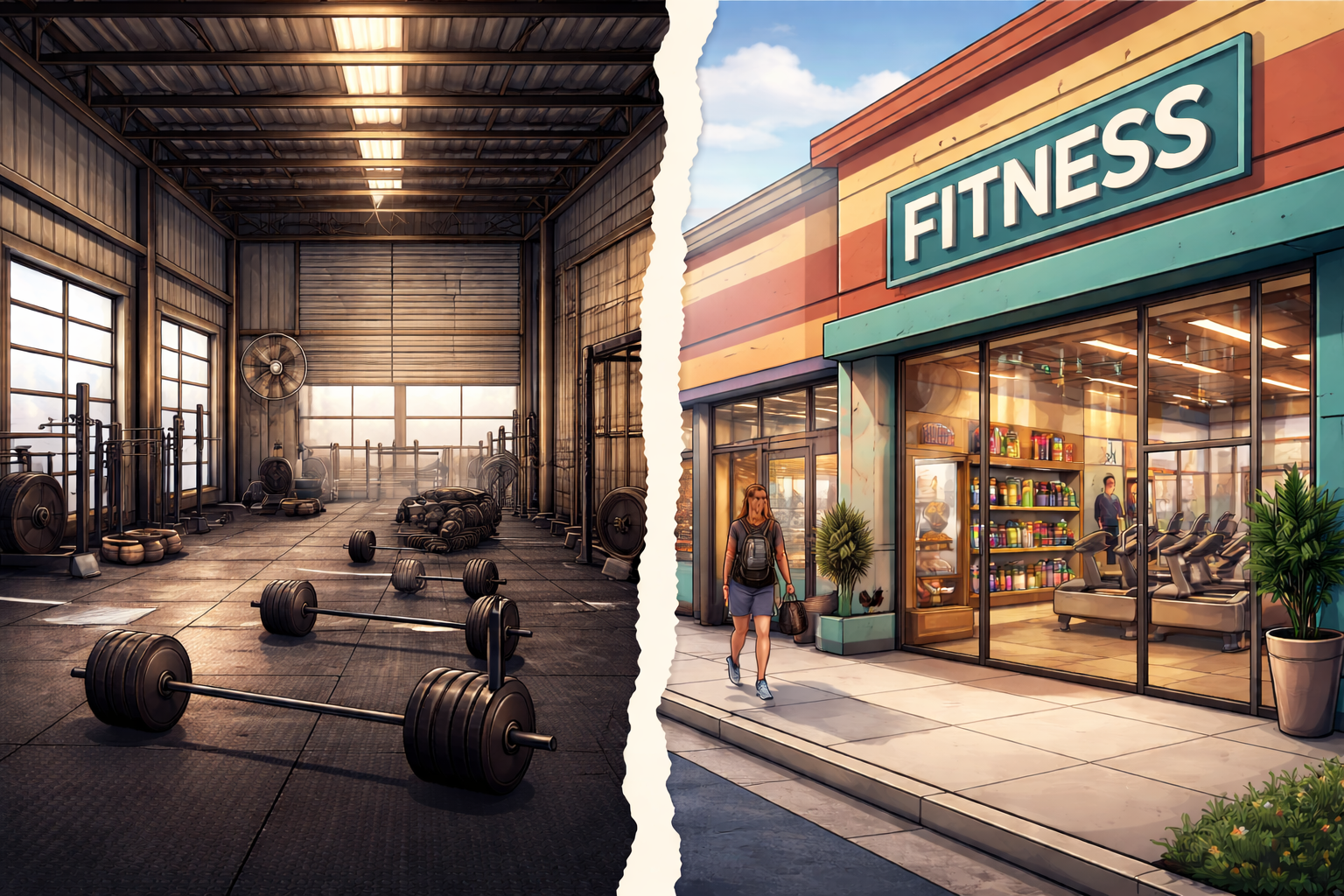
Open any commercial real estate listing site and you’ll see something confusing.
Two buildings.
Same city.
Same square footage.
One costs $30 per square foot.
The other costs $10.
Same size.
Same city.
So what gives?
Nine times out of ten the difference comes down to one thing:
Retail vs Industrial.
And understanding the difference is one of the earliest decisions that quietly shapes your gym's future.
Different rent.
Different landlords.
Different noise tolerance.
Different member experience.
Pick the wrong one and you’ll feel it every day you unlock the doors.
Pick the right one and the building fades into the background while your business grows.
Let’s break it down.
First: Translate The CRE Jargon
Commercial real estate has a habit of turning simple ideas into complicated terms.
So let's simplify.
Retail Space
Retail space is designed for businesses that interact with customers all day.
Think places like:
Coffee shops
Restaurants
Hair salons
OrangeTheory
Smoothie shops
Retail real estate exists for one reason:
Convenience.
You’ll usually find it in:
Shopping centers
Strip malls
Mixed-use developments
Retail buildings prioritize:
Visibility
Parking
Traffic
Consumer access
Which makes them appealing for gyms that depend on discovery and walk-in interest.
Industrial Space
Industrial space was not built for customers.
It was built for work.
Warehouses
Distribution centers
Contractor yards
Manufacturing
These buildings prioritize:
Big open space
Truck access
Durability
Low cost
But that combination happens to work very well for many gyms.
Especially strength gyms.
The Case For Retail
Retail locations give gyms something extremely valuable:
Visibility.
People drive past your sign.
People discover your gym without searching online.
Members can stop by before work, after work, or between errands.
Retail space also tends to offer:
Better lighting
Better parking
Cleaner surroundings
A more polished customer experience
This is why boutique fitness brands prefer retail.
Studios like:
Yoga
Pilates
Group fitness
Personal training studios
Often thrive in retail environments.
The Downside Of Retail
Retail landlords know their locations are valuable.
So you pay for it.
Higher rent.
Higher operating expenses.
Stricter leases.
Retail neighbors may also be less tolerant of noise.
Dropping barbells next to a spa or yoga studio can create tension quickly.
Retail space is great for visibility.
But it comes with higher expectations and higher costs.
The Case For Industrial
Industrial space became popular with gyms for three simple reasons.
Lower rent.
Higher ceilings.
No one complains about noise.
Many warehouse buildings offer:
18–24 foot ceilings
Wide open floor plans
Concrete floors that can handle heavy equipment
For strength gyms, CrossFit gyms, and performance facilities, that setup works beautifully.
Industrial space also tends to be cheaper by a large margin.
Which gives owners more breathing room financially.
The Downside Of Industrial
Industrial buildings look great on paper.
Cheap rent.
Huge ceilings.
Wide open space.
Then zoning enters the chat.
Most industrial buildings are zoned for things like:
Warehousing
Manufacturing
Distribution
Contractor storage
Cities group these uses together because they create noise, truck traffic, and other industrial activity.
A gym, however, is not considered an industrial use.
In zoning language, a gym is usually classified as a retail or commercial use.
Why?
Because people are coming and going all day.
Cars are parking.
Customers are visiting the property.
In other words, from the city’s perspective:
A gym is a customer-facing business.
And many industrial zones are not designed for customer traffic.
That means opening a gym in an industrial building can sometimes require:
A special use permit
A conditional use permit
Or zoning approval from the city
Sometimes that process is easy.
Sometimes it’s a months-long headache involving planning boards and public hearings.
This doesn’t mean industrial space is a bad option.
Many gyms operate successfully in industrial buildings.
But it does mean one thing:
Never assume a building is approved for gym use just because another gym operates somewhere nearby.
Zoning can change block by block.
Always confirm with the city before you get too deep into a deal.
The Real Decision
Most people frame this as:
Retail vs industrial.
But the real decision is simpler.
Visibility vs affordability.
Retail buys you visibility and convenience.
Industrial buys you cheaper rent and operational freedom, but may have a zoning or parking issue.
Neither one is automatically better.
Unfortunately, it's a much more nuanced conversation for us to have (which is why you should book a Discovery Call)
Retail Usually Works Better For
Boutique studios
Personal training gyms
Yoga and Pilates
Higher-end concepts
These businesses rely on convenience and discovery.
Retail helps that happen.
Industrial Usually Works Better For
CrossFit gyms
Strength gyms
Athletic performance facilities
Large open training spaces
These businesses prioritize space, durability, and lower rent.
Industrial supports that model well.
The Mistake That Costs Gym Owners The Most
The biggest mistake is chasing the cheapest building.
Real estate is not just an expense.
It is part of your marketing.
A visible retail location might cost $4,000 more per month…
…but generate 20 additional memberships.
That math matters.
At the same time, paying retail rent for a barbell club that doesn’t need visibility makes little sense.
Choose the building that fits the business model.
Not the one that looks cheapest on a spreadsheet.
If you’re evaluating sites and want help understanding the real trade-offs between buildings, that’s exactly what we do.
We help gym owners lease and buy buildings across the country.
No cost to you.